3.18.2016

CHESTERS ROMAN FORT

We will arrive late this afternoon in Edinburgh, but on the way, we'll stop to explore Chesters Roman Fort built during the construction of Hadrian's Wall. Our time-frame this morning is about 124 CE.   Early on, Hadrian's wall was simply that--a wall.  It marked the northern limit of the Roman Empire, and also served as a defensive fortification.  It doesn't divide England from Scotland--it varies in distance from the actual border, but was designed to separate the Romans from the Barbarians in the north.  I'm learning there are some tensions between Scotland and England that, no doubt, date back millenia...


Chesters Roman Fort seems large to me, but we are only seeing a small portion.  Much of it has been carted away as stones for other buildings, and much remains underground.  It was originally constructed to guard a bridge that carried the Military Way Roman Road across the River Tyne.  It housed up to 500 cavalrymen, plus supporting staff and civilians.  The troops who garrisoned here weren't Roman troops.  They were called Auxiliary Troops and were gathered from across Europe including Northern Spain, the Rhineland in Germany, and Bosnia-Herzegovina.

The view above is the area of the fort closest to the river and the remains of the Roman bridge.  This area primarily housed the baths.


It takes a squint, but you can see ruins across the River Tyne that are the remains of what are called "massive" abutments.  The Saxons dismantled the Roman bridge in the late 600's in order to use the stones in the building of a church--today's Hexham Abbey in nearby Hexham., Northumberland.


Farther from the river, we find the stable-barracks in which the men and their horses lived.  I'm not exactly sure how they divided up the square footage, but it seemed to work for them.  These barracks were probably built in the second century when a new group of cavalry arrived.  By this time, the numbers had been reduced to about 360 or so.  Plus their horses, of course.


Peter is demonstrating the width of this bit of Hadrian's Wall that still remains.  When it was originally built, the wall varied from nine feet wide in the east, where the wall was built entirely of stone, to as much as twenty feet wide in the west, where the wall was mainly constructed of dirt.  The height also varied from twenty feet high down to eleven feet.  Much of that seemed to depend on materials at hand.  Wikipedia mentioned that when Hadrian's Wall was completed, it might have been plastered and then white-washed as an example of the sophistication and glory of the Roman Empire.


This is an oven--or the remains of an oven--used to bake bread for the soldiers.  If I understood correctly, this was a kind of bee-hive oven in which a fire would be built.  As that fire died down, the dough  was placed inside and baked by the heat dissipating from the rocks.  Really, it's a pretty simple concept, but I can imagine, over time, the sophistication (and competition) that arose from individual bakers and their take on perfect dough, right-sized fires, temperature variations outside and inside the oven and all of the many etc's. that go with the baking and breaking of bread.


Not to mention the variations of millstones.  We saw dozens of millstones, all of which were discovered here at Chesters Fort.  My son is a miller (How many mothers can say that?), so I have some interest in millstones and the magic they create.  This photo came from the little museum nearby which contains all sorts of artifacts from the excavations at Chesters Fort.  It's a tiny museum, over one-hundred years old, and well worth the look...as are all Quintessential British sites!

3.09.2016

OUR DAY IN YORK

We left Harrogate about 9:30 a.m. for a late morning tour of York Minster.  The Minster is the seat of the Archbishop of York...second only to the Archbishop of Canterbury.  I'm not completely sure how all of that works but, in this case, coming in second is still quite impressive.


Much of the Minster dates to the 13th and 14th centuries, but Christendom has roots here from 180 CE--or so the story goes.  The first recorded church on this site was a wooden structure built in 637 CE for the specific purpose of baptizing Edwin, King of Northumbria.  If Wikipedia is to be believed, the destruction and resulting construction never stopped after that, with each iteration being a bit larger and a little more grand.  I'm convinced that a detailed tour of the Minster would take days and, no doubt, leave your head spinning with names and dates and deaths and births.  It is beautiful and...


towers over all of York.  We were turned loose later in the day, but could always find our bearings by referencing the Minster.

Considering (again) that we are on a tour titled "Quintessential Britain," today has been designated as Fish and Chips and Mushy Peas day.  We have waited a good number of days for the quintessential fish and chips, and now is our time.  I'm really not a fish person, but I do know that if you take a fresh piece of mild white fish, dip it in a goodly amount of well-prepared batter, and gently lower it into a fresh, and bubbling oil, the result will be quite good...and it was.  Ditto the chips.  I had been a bit worried about mushy peas, but they were really good.  I haven't mushed any since I've been home, but I just might give it a try.

This afternoon we're on our own (so to speak) to wander at will, or wander with Peter.  We choose Peter who points out various historical buildings, shopping areas, museums and parks, before we unfold our city map and give it a go by ourselves.  We have a friend who loves anything to do with railroads, so we walk to the Railway Museum (Per Trip Adviser, the Number One attraction in York) to see if we can actually find it, and when we do, purchase a little something for him.  We're successful on all counts!

This is Sunday, so those of us who wish are meeting back at the Minster for Evensong.  I have really looked forward to this experience and it doesn't disappoint.  We didn't realize that the Minster Choir was on a summer break, and so this evening, our choir will have come all the way from Kentucky.  I would have loved to hear the Minster choir, but the Kentuckians were wonderful!  The Dean of York Minster is a woman--Vivienne Faull, and she delivered the sermon.  Between her accent, the acoustics and the sound system, I didn't understand it all, but I know she got a word or two on women and equality worked into it.  Good for the Dean!


This will be our final night at The Majestic Hotel in Harrogate.  She does resemble an aging grand dame on the outside, but her interior has held up remarkably well.  Her large public rooms are elegant, and her dining room adds just a touch of formality to our meals.  Unfortunately, plumbing appears to have been an "add on" and pipes (maybe a little like my wrinkles) run helter-skelter over her well-maintained but fading face.

This evening, a young Indian couple are celebrating their wedding at The Majestic and it is a perfect setting.  Beautifully dressed women and handsome young men fill the main floor rooms and wide hallways.  Tons of kids--all dressed in their best--are skittering up and down the wide curving staircase, laughing all the way.  We can hear the music and quietly smile at the pure joy seeping through this grand lady and our evening.  A perfect day's end.          

2.28.2016

HOWARD CASTLE & RIEVAULX ABBEY

What struck me during our visit at Howard Castle, was its juxtaposition with the last season of Downton Abbey which would be starting soon in England.  I don't know about you but I have loved every minute of that show, and I'm very worried as to what I will do when it ends in a few short weeks.  I began watching Masterpiece Theatre in 1971 which is...forty-five years ago, and I think Downton Abbey has been my all time favorite.  I completely typed out "forty-five" as it seems not quite as shocking as "45".  

As we know, the 20th Century was not kind to the landed gentry in Great Britain, and it quickly became obvious that the huge castles and manors would no longer be able to support themselves...as has happened with Castle Howard.  Whereas, family still lives here, they occupy only a small apartment on an upper floor and must live with hundreds of visitors each day wandering through what was once their home.  The Castle has been lent out for filming, thousands of acres have been sold, and much of the damage from a massive fire in 1940 remains untended.  She is a grand lady, and still beautiful in that elegant way the very rich can manage but, sadly, her days are coming to an end.


Welcome to this grand Castle.  Research told me that this is the south facade of this lovely home although I would have sworn it was west.  If you walk up the not-so-elegant stairs--not so elegant because this is the back door--and turned around to face south, you would see acres and acres of manicured lawn and trees, with imaginative sculptures placed here and there.  Pure gorgeousness. From this view Castle Howard doesn't look terribly large, but at each end, monstrous wings reach toward the north.  I think I read the house has 145 or so rooms.  If the few we saw were any indication, decorated to within an inch of their life, an invitation to Castle Howard would have been an awe-inspiring event back in the day.


A small corner of the back yard...


Contained within the vast landscape are walled gardens.  This particular garden--The Rose Garden--displayed this memorial just inside its gate.  GH would be George Howard, father of the current owner, Simon. Cecilia was apparently his beloved wife.  I love sentimentality.  I strive to be the type of woman whose husband would dedicate something in her honor...with sweet words about me prominently displayed.  Yes, I definitely would like that.  And, I'm happy for Cecilia.

Castle Howard is about 15 miles north of York--our stopping place last night.  It's been the home of the Carlisle branch of the Howard family for more than 300 years.  We learned that this home is not a real castle, but qualifies to be called that because an actual military castle once stood here.  My pictures do not do it justice at all, but if you watched Brideshead Revisited (which I didn't--what was I thinking?) this was where it was filmed.

********************

Now we're driving toward Rievaulx Abbey...or the ruins of Rievaulx Abbey.  It's raining in earnest as we approach these beautiful remains, and the photos I had intended to take would have been exceptional indeed.  I once learned it was possible to take very nice pictures when your camera was securely tucked inside a protective plastic bag, and I took that to heart.  Not close enough, however, as I had no plastic bag on this journey.  It was a bit like some of England's history..."For lack of a horse the battle was lost..." or something similar.


'Tis a moody setting, to be sure.  The Cistercian monks of the 12th and 13th centuries lived well here, working hard and creating a great deal of wealth.  They diverted the River Rye in order to have more flat for farms, mined lead and iron, and raised sheep--selling the wool throughout Europe. However, by 1381, their fortunes had turned.  Black Death swept through England and their revenues dropped significantly when an epidemic of sheep scab wiped out their flocks.  Finally, in 1538, Henry VIII dissolved the abbey--heaping insult upon injury when the buildings were made uninhabitable and stripped of everything of value.


We spent some time in the small museum near the abbey that told its story in detail, then moved on to lunch in the Rievaulx Town Hall where we were able to visit one on one with a few of the folks who live near here.  They were farmers--meaning My Sweet Babboo had a wonderful time asking all sorts of questions.


Rievaulx Abbey strikes me (as did the moors) as a perfect place to wander on your own.  There are hundreds of stories to be uncovered here, and sometimes that's best done in solitude. 

2.05.2016

MEETING THE BRONTE'S

When I was about to graduate from Eighth Grade, my Aunt Pauline asked what I would like as a celebratory gift.  (Aunt Pauline could get away with words like celebratory.)  I wasn't as hesitant then, as I am now, in requesting specific items, and I quickly answered I wanted two books: Wuthering Heights by Emily Bronte and Jane Eyre by Charlotte Bronte.  I was into classics at the time, convinced that dreamy, thoughtful, literary women (like me) treasured the Bronte's.

A few minutes ago, I walked into the living room and pulled both books off the shelf and, per their "Ex Libris" note, they were gifted in 1958. Wuthering Heights is very near the falling apart stage.  It must have been my favorite...I never hesitated to read a book again and again if I really liked it.  Jane Eyre cracks when I open it, although I know I read it at least once.  The fact that it is so seemingly untouched makes me think I should choose it as our Book Club book in June.  That may inspire a mutiny, but I'm going to try it anyway.

On this late July morning, our Road Scholar itinerary states that we will drive to Haworth, arriving about 11:00 a.m.  At that point we have two choices:  We can visit the "Bronte" Church and woolen museum or we can participate in a 1.5 mile walk on the moors.  There is no doubt that I will choose the moors. It is the "Bronte" thing to do...particularly in honor of Emily who, we know, spent hours and hours wandering that vast grassland.  I believe it's commonly believed that the moors surrounding Haworth were her setting for Wuthering Heights.


At this point, we're just walking out from Haworth.  We're navigating an uneven stone path that is rising gently toward the moors.  Our Peter is leading us, as well as providing entertaining tales of this area and what sets it apart from other rural spots in England.


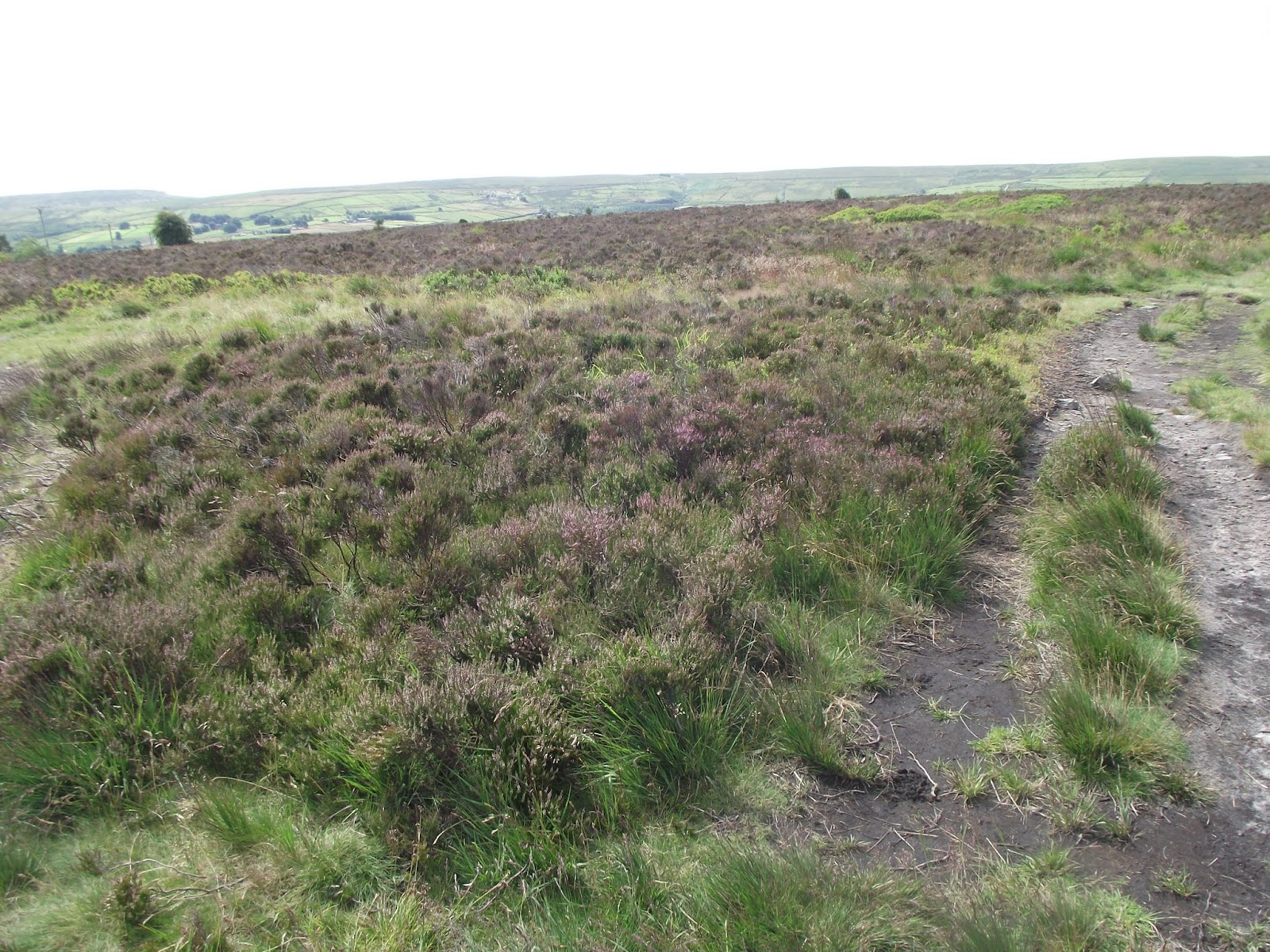
Even though this is Heather Moorland, in my opinion, it is not a particularly pretty landscape, but I was expecting that.  Depending on your imagination, I think the moors can match whatever your mood, at the time, might be.   And that, perhaps is why they remind me so much of the high-plains of Southwest Kansas...although they are definitely more green.  People who live on or near the high-plains grow up with distant horizons that spread from here to way past there.  The sky is immense and the colors range from brilliant blue, to blood red, to frightening roiling black.  Every day is different and, for those who love it, the absence of trees is just what they like.  I've lived in the middle of those plains, but I need my trees.  Thus, I'm actually surprised during this walk at the sense of openness and freedom and fresh air and space to twirl and run and laugh out loud.

I didn't do any of those things, though.  Maybe I should have...


This is a pretty day for us--it's not raining, it's not terribly windy (although the moors are known for wind), but the sky is gray.  Heather moorland, despite its lovely purple isn't a colorful place.   It's more a place of shades...a little lighter here and darker there, all nicely blended together.


What's this?  There seem to be a few scattered about.  Yes, it is a book, not really carelessly tossed aside as it seems, but part of a larger installation placed as a memorial to Charlotte, Emily, Branwell and Anne.  Three are buried in the family plot in Haworth while the fourth, Anne, was buried in Scarborough.  More from necessity, I believe, than choice.  They were so young...


The walk on the moors was wonderful and I'll always treasure that time.  But, lunch is beckoning, and we walk back into Haworth to meet the rest of our group at the Old White Lion.  Lunch is Cottage Pie and we ate every morsel.  Delicious!


We spent the rest of the afternoon touring the Bronte Parsonage Museum...not to be missed if you're a Bronte fan.  It's a tiny house by our American standards, but lovely and intimate.  The tour is self-guided, so look and read and wander to your heart's content.  The dining room was my favorite as that is where the four children would gather to do their writing.  They read their work to each other as they worked and collaborated on their little plays and performances and poems.  It does sound idyllic, but life in the mid-1800s was a serious affair.  Lack of today's medical care and sanitation did not make for long and happy lives, and the Bronte's seem particularly star-crossed.

Another wonderful day on the road.  We'll sleep tonight in Harrogate.

1.20.2016

CHESTER

Since this is Thursday, we know we're in Chester, and beginning--what turns out to be--a beautiful,  but very relaxed day. These old folk need that every now and then!  We're at the Chester Cathedral where we're invited to wander at will, after which we'll have a guided walk with expert talk.. 


This is actually the rear of the Cathedral and, in my mind, the more attractive view thanks to the green, green grass and blooming bushes and flowers.  The front is set on the street and thus, while equally elaborate in design, is much more gray.


I hope it's not just me, but when we visit Cathedral after Cathedral, I have a tendency to become a little blase and begin to take this beautiful and intricate artwork for granted.  I know there will be more tomorrow or even later today, and forget to appreciate the details.  I lost my "live in the moment" intention for a little bit this morning.


Ah--but not here.  I loved this secluded and tiny cloister (Chester Cathedral was once a Benedictine Monastery) with its magnificent sculpture (only a little of which is in the photo).  I may have spent nearly as much time here among the green, as wandering through the Cathedral itself.  With this kind of atmosphere, I could become contemplative!  Maybe.

An unexpected highlight today was lunch in the Cathedral Refectory.  Being a Good Catholic Girl, I'm all about an historic refectory--complete with detailed ceiling, stained glass windows, and a stone pulpit built into the wall for the monk who read scripture while the others ate their daily repast...which, no doubt, wasn't nearly as good or generous as ours.  And, we didn't have to eat in silence as I had feared.

We're off now for a bit of a walk around Chester--literally, as we're walking on Chester's Roman walls gaining access to views of some very posh gardens.  We visited "The Rows"--two storied shopping arcades, and the Roman ampitheatre which is still being unearthed.


This house (besides being a bit unfocused) is special for the reason that its owner-family was untouched by the plague back in the day.  Everyone here survived--Thus the writing below the window.


It's late afternoon and we're walking along the canal back to the hotel with Peter--we, being the non-shopping group who are ready to put our feet up with a half-pint.  As I mentioned in the beginning, it's nice to have a low-key--but beautiful--day every now and then.  We'll be raring to go by tomorrow.

1.05.2016

TO STEAL A MOUNTAIN...

I mentioned in the last post that we would have two more stops after Conwy Castle.  The first of which was The Welsh Slate Museum near Llanberis, while the second will be an optional hike to Dolbadarn Castle.  Let's begin with the saga of slate..

I've never questioned my love of slate.  In my little home town there were a few houses which were roofed with slate.  They were usually cute little Tudors scattered through an area of town called Russell Heights, built for easy access to The Dodge City Country Club.  In contrast to Dodge City's strict grid system of streets, Russell Heights luxuriated in wide and curving "drives". LaMesa Drive, Country Club Drive and etc.  I lusted to live in Russell Heights and, for even longer, dreamed dreams of a slate roof...until I visited the Welsh Slate Museum.

My research has told me that slate is a fine-grained, foliated, homogeneous metamorphic rock derived...  Yes, it does go on for two or three more sentences so, let's just suffice it to say that slate is complex.  It can be used for roofing and floor tiles--interior and exterior.  And, if you have a certain maturity, you may remember that slate was also used as blackboards in schools, and (before my time) individual writing slates.  And slate, for many years was quarried from those rich and lush and green mountains in northern Wales.  Two of the largest slate quarries in the world were located in the area of Wales where we are now visiting.


And this is the result.  I suppose I'm being a bit dramatic, but after yesterday's lessons at Ironbridge, I'm becoming a bit sensitive to the environmental results of our human longing for wealth.  Lest you feel I might be going overboard a bit, let me tell you about the documentary film that we saw on our first stop at the museum.  As the lights dimmed and the music rose, a male voice repeated the quote Peter had told us last evening:  "Steal a sheep from the mountain and you will be hanged. Steal a mountain and you will be made a lord."

Slate mining in this area began in the late 1700's.  Business began to boom in the early 1800's and continued until production ceased in the mid-1900's.  Slate was removed in an opencast method--like our open pit mining here in the United States.  Thus, the scars of the mountainsides.


Yes, I know men need work to feed their families, and villages need employment in order to exist and provide the necessities and niceties of community.  But, whew!  It does take a toll.  Unfortunately, sometimes a toll that doesn't go away.


Peter gave us the option of spending more time at the Slate Museum--which was really interesting--or participating in an optional hike to Dolbadarn Castle.  We opted for the castle, and the hike up was beautiful. Green and lush, of course.  I know I say that a lot, but remember I was raised on the high plains of Kansas before moving to the deserts of Arizona.  I can't get enough of green and lush.


And water.  Have I mentioned water...  I could watch and listen to the water all day.  However, this was a hike and  we are on our way to the castle.   Llywelyn the Great, a Welsh prince, built this castle in the 13th century.  It was huge, at the time, but all that is left standing is this tower, immortalized by JMW Turner about 1800 in one of his more famous paintings.  A painting that I think looks both romantic and a bit threatening.  Kind of like the cover of a "bodice ripper" novel.


With enough height, you can see the general layout of the castle from the foundation stones still visible above the grass.  Apparently, the castle was dismantled from time to time to build other castles or fortifications and now is simply a tourist attraction.  It's a beautiful walk to get here, and the views from this hill (with the exception of the scarred mountainsides) are lovely.

The surprising part of this trip for me was the opportunity for optional hikes.  I loved that!  I'm not a hiker by nature, but I could be persuaded.  The views are so different every few feet, and I remembered some advice I learned in Photo Club.  "Don't forget to turn around."  The views behind you may be more spectacular than those ahead of you.  Don't miss them!

12.18.2015

CONWY CASTLE

Our first stop this morning (there will be three major excursions today) is Conwy Castle.  If anyone tells you that a castle is a castle is a castle...well, maybe not.  Personally, I was quite taken with Conwy Castle.


We're in North Wales again today, tucked up very close to the sea.  Not much stands between us and the Arctic Circle except the distant Faeroe Islands.  Conwy Castle was built by King Edward I who, in the late 1200's, conquered Wales.  He cleared away the existing Cistercian Monastery, and built this huge castle as a not-so-subtle reminder to the Welsh people that he was a powerful man indeed.  Per Wikipedia, the laborers who built this castle (recruited throughout England) worked on it only in the summer.  Considering the wind-chill in northern Wales in the middle of winter, that was an uncommon kindness.


Edward had only been at the castle a few years before Madog ap Llywelyn rebelled against English rule in Wales. Peter (our leader) described in some detail the months-long assault on the castle in the middle of winter--including Christmas of 1295.  Legend has it that even though times were terrible (obviously), Edward shared his private supply of wine among those living at, and fighting for the castle.  Now, there is an officer and a gentleman.


I'm assuming the wine story alone may account for the reverence with which Edward is regarded at this castle.  I was mightily impressed with this sculpture of the head of Edward I.  It's (accurately) described as a "ghostly presence".  Considering I had walked by it and under it without ever noticing it, I'd have to agree.


Even though there appear to be fireplaces galore--one actually lit with a digital image of a fire--I'm sure it was cold and damp and grey and frightful during the rebellion.  And dark.  At that latitude, the sum rises late and sets too  early.  I can't imagine the isolation.


We climbed a relatively short, but narrow and steep circular staircase to visit Edward's chapel which, I would maintain, was an oft-used refuge.  It you consider the powerlessness of an English King, far from home, under seige from Madog ap Llywelyn (the hometown hero) in the dead of winter...prayers are pretty much the only thing you've got going..


I'm always struck, when outside the United States, at the lack of accessibility for those in wheelchairs or using crutches.  At the same time, I'm horrified by the lack of protective barriers, railings, modifications and etc., that just don't exist; even when we old people are climbing around ancient castles. Yes, the Welsh are hardy, but so are the English and the French as evidenced by the sheer terror I often feel while exploring their sites.  I suppose, if one has to go, one might as well be wiped out in a horrific fall from the ramparts of a castle during a magnificent trip to Wales.

It appears that Conwy Castle figured in the history books for some centuries.  It has been saved from time to time, then lost again.  Hard fought battles brought it back into play, but neglect and harsh weather did its damage.  Finally, over the last 200 years, Conwy Castle has been regularly repaired and maintained, and today, as a UNESCO World Heritage Site, hosts 200,000 or so tourists each year.

I don't know if it's my favorite castle, but I highly recommend it.  Bring a jacket, umbrella, and sturdy, but comfortable shoes.