1.20.2016

CHESTER

Since this is Thursday, we know we're in Chester, and beginning--what turns out to be--a beautiful,  but very relaxed day. These old folk need that every now and then!  We're at the Chester Cathedral where we're invited to wander at will, after which we'll have a guided walk with expert talk.. 


This is actually the rear of the Cathedral and, in my mind, the more attractive view thanks to the green, green grass and blooming bushes and flowers.  The front is set on the street and thus, while equally elaborate in design, is much more gray.


I hope it's not just me, but when we visit Cathedral after Cathedral, I have a tendency to become a little blase and begin to take this beautiful and intricate artwork for granted.  I know there will be more tomorrow or even later today, and forget to appreciate the details.  I lost my "live in the moment" intention for a little bit this morning.


Ah--but not here.  I loved this secluded and tiny cloister (Chester Cathedral was once a Benedictine Monastery) with its magnificent sculpture (only a little of which is in the photo).  I may have spent nearly as much time here among the green, as wandering through the Cathedral itself.  With this kind of atmosphere, I could become contemplative!  Maybe.

An unexpected highlight today was lunch in the Cathedral Refectory.  Being a Good Catholic Girl, I'm all about an historic refectory--complete with detailed ceiling, stained glass windows, and a stone pulpit built into the wall for the monk who read scripture while the others ate their daily repast...which, no doubt, wasn't nearly as good or generous as ours.  And, we didn't have to eat in silence as I had feared.

We're off now for a bit of a walk around Chester--literally, as we're walking on Chester's Roman walls gaining access to views of some very posh gardens.  We visited "The Rows"--two storied shopping arcades, and the Roman ampitheatre which is still being unearthed.


This house (besides being a bit unfocused) is special for the reason that its owner-family was untouched by the plague back in the day.  Everyone here survived--Thus the writing below the window.


It's late afternoon and we're walking along the canal back to the hotel with Peter--we, being the non-shopping group who are ready to put our feet up with a half-pint.  As I mentioned in the beginning, it's nice to have a low-key--but beautiful--day every now and then.  We'll be raring to go by tomorrow.

1.05.2016

TO STEAL A MOUNTAIN...

I mentioned in the last post that we would have two more stops after Conwy Castle.  The first of which was The Welsh Slate Museum near Llanberis, while the second will be an optional hike to Dolbadarn Castle.  Let's begin with the saga of slate..

I've never questioned my love of slate.  In my little home town there were a few houses which were roofed with slate.  They were usually cute little Tudors scattered through an area of town called Russell Heights, built for easy access to The Dodge City Country Club.  In contrast to Dodge City's strict grid system of streets, Russell Heights luxuriated in wide and curving "drives". LaMesa Drive, Country Club Drive and etc.  I lusted to live in Russell Heights and, for even longer, dreamed dreams of a slate roof...until I visited the Welsh Slate Museum.

My research has told me that slate is a fine-grained, foliated, homogeneous metamorphic rock derived...  Yes, it does go on for two or three more sentences so, let's just suffice it to say that slate is complex.  It can be used for roofing and floor tiles--interior and exterior.  And, if you have a certain maturity, you may remember that slate was also used as blackboards in schools, and (before my time) individual writing slates.  And slate, for many years was quarried from those rich and lush and green mountains in northern Wales.  Two of the largest slate quarries in the world were located in the area of Wales where we are now visiting.


And this is the result.  I suppose I'm being a bit dramatic, but after yesterday's lessons at Ironbridge, I'm becoming a bit sensitive to the environmental results of our human longing for wealth.  Lest you feel I might be going overboard a bit, let me tell you about the documentary film that we saw on our first stop at the museum.  As the lights dimmed and the music rose, a male voice repeated the quote Peter had told us last evening:  "Steal a sheep from the mountain and you will be hanged. Steal a mountain and you will be made a lord."

Slate mining in this area began in the late 1700's.  Business began to boom in the early 1800's and continued until production ceased in the mid-1900's.  Slate was removed in an opencast method--like our open pit mining here in the United States.  Thus, the scars of the mountainsides.


Yes, I know men need work to feed their families, and villages need employment in order to exist and provide the necessities and niceties of community.  But, whew!  It does take a toll.  Unfortunately, sometimes a toll that doesn't go away.


Peter gave us the option of spending more time at the Slate Museum--which was really interesting--or participating in an optional hike to Dolbadarn Castle.  We opted for the castle, and the hike up was beautiful. Green and lush, of course.  I know I say that a lot, but remember I was raised on the high plains of Kansas before moving to the deserts of Arizona.  I can't get enough of green and lush.


And water.  Have I mentioned water...  I could watch and listen to the water all day.  However, this was a hike and  we are on our way to the castle.   Llywelyn the Great, a Welsh prince, built this castle in the 13th century.  It was huge, at the time, but all that is left standing is this tower, immortalized by JMW Turner about 1800 in one of his more famous paintings.  A painting that I think looks both romantic and a bit threatening.  Kind of like the cover of a "bodice ripper" novel.


With enough height, you can see the general layout of the castle from the foundation stones still visible above the grass.  Apparently, the castle was dismantled from time to time to build other castles or fortifications and now is simply a tourist attraction.  It's a beautiful walk to get here, and the views from this hill (with the exception of the scarred mountainsides) are lovely.

The surprising part of this trip for me was the opportunity for optional hikes.  I loved that!  I'm not a hiker by nature, but I could be persuaded.  The views are so different every few feet, and I remembered some advice I learned in Photo Club.  "Don't forget to turn around."  The views behind you may be more spectacular than those ahead of you.  Don't miss them!

12.18.2015

CONWY CASTLE

Our first stop this morning (there will be three major excursions today) is Conwy Castle.  If anyone tells you that a castle is a castle is a castle...well, maybe not.  Personally, I was quite taken with Conwy Castle.


We're in North Wales again today, tucked up very close to the sea.  Not much stands between us and the Arctic Circle except the distant Faeroe Islands.  Conwy Castle was built by King Edward I who, in the late 1200's, conquered Wales.  He cleared away the existing Cistercian Monastery, and built this huge castle as a not-so-subtle reminder to the Welsh people that he was a powerful man indeed.  Per Wikipedia, the laborers who built this castle (recruited throughout England) worked on it only in the summer.  Considering the wind-chill in northern Wales in the middle of winter, that was an uncommon kindness.


Edward had only been at the castle a few years before Madog ap Llywelyn rebelled against English rule in Wales. Peter (our leader) described in some detail the months-long assault on the castle in the middle of winter--including Christmas of 1295.  Legend has it that even though times were terrible (obviously), Edward shared his private supply of wine among those living at, and fighting for the castle.  Now, there is an officer and a gentleman.


I'm assuming the wine story alone may account for the reverence with which Edward is regarded at this castle.  I was mightily impressed with this sculpture of the head of Edward I.  It's (accurately) described as a "ghostly presence".  Considering I had walked by it and under it without ever noticing it, I'd have to agree.


Even though there appear to be fireplaces galore--one actually lit with a digital image of a fire--I'm sure it was cold and damp and grey and frightful during the rebellion.  And dark.  At that latitude, the sum rises late and sets too  early.  I can't imagine the isolation.


We climbed a relatively short, but narrow and steep circular staircase to visit Edward's chapel which, I would maintain, was an oft-used refuge.  It you consider the powerlessness of an English King, far from home, under seige from Madog ap Llywelyn (the hometown hero) in the dead of winter...prayers are pretty much the only thing you've got going..


I'm always struck, when outside the United States, at the lack of accessibility for those in wheelchairs or using crutches.  At the same time, I'm horrified by the lack of protective barriers, railings, modifications and etc., that just don't exist; even when we old people are climbing around ancient castles. Yes, the Welsh are hardy, but so are the English and the French as evidenced by the sheer terror I often feel while exploring their sites.  I suppose, if one has to go, one might as well be wiped out in a horrific fall from the ramparts of a castle during a magnificent trip to Wales.

It appears that Conwy Castle figured in the history books for some centuries.  It has been saved from time to time, then lost again.  Hard fought battles brought it back into play, but neglect and harsh weather did its damage.  Finally, over the last 200 years, Conwy Castle has been regularly repaired and maintained, and today, as a UNESCO World Heritage Site, hosts 200,000 or so tourists each year.

I don't know if it's my favorite castle, but I highly recommend it.  Bring a jacket, umbrella, and sturdy, but comfortable shoes.  

12.10.2015

BLISTS HILL & FARNDON PARISH CHURCH

Before our trip to the UK, I began researching the different places we would visit, and the sights we would see.  On this day, we will be leaving our lovely little Three Ways House Hotel, then stopping by the Iron Bridge Gorge Museum, Blists Hill Victorian Village and Farndon Parish Church.  We will sleep tonight in Chester.

Information was a little scarce on these three sites.  Unless something has changed since, Rick Steves ignored them altogether.  The Iron Bridge Gorge Museum of our itinerary, is actually one of ten related museums located throughout this particular area of England.  I've picked up that the beautiful gorge we will see, was once a great ironworks center, made practical because of the nearby coal deposits.  It is all about the Industrial Revolution.  Unfortunately, I found the Industrial Revolution and all that went with it, to be terribly boring when I was in school and, in my secret heart of hearts, I'm wondering why Road Scholar would see fit to drag us here.

We drove first into the village of Ironbridge, parking in one of England's lovely car and coach parks.  We love car and coach parks, because we know a loo will be close by and, being older, loos are always welcome.  They are generally clean, neat, and nearly always free.

After we regrouped, we began a walk along the River Severn to the first cast-iron bridge ever built.  Ever.  Today, it's cited as one of the symbols of the Industrial Revolution.


I must admit it is a beautiful bridge, and I can't imagine the complexities of building this in the late 1700s.  And, the guidebooks were right...this is a gorgeous area.  As we walked across the bridge (motor traffic is forbidden--or strictly limited now) the gorge, both to our right and left were remarkably lush and green..


At one point in time, I stopped listening to many of the facts and figures and simply began finding Quintessential British scenes along the way.  Sometimes I still wonder:  Why not England, Lord? Why Dodge City?  But, I'm lucky to be here at all, so I shouldn't get picky.  But England would have been nice. 


The little village of Ironbridge wasn't nearly as deserted as it looks here.  I need to remember that it was an industrial town and they weren't built for beauty and comfort.   Here, it becomes easy to imagine this beautiful gorge buried under the dense, black, greasy smoke of the coal-fired furnaces, as they burned hot enough to produce the pig iron of the times.  I thought especially of the children who grew up in this environment.  Their life spans would have to have been shortened as their little lungs processed the residue of all that pollution.  It's not windy here.  The smoke would have laid heavy on this gorge and all who lived in it.

As we went through the museum, we noticed a small exhibit showing the delicate and elaborate china that was produced here.  Young girls were brought in and taught to paint the china, and it was exquisite.  What a contrast to the roar and flame and crash of iron production.  The idea of girls in their tween years leaving home to work here, amidst the roar of blast furnaces was too much. 


The English always seem prepared for all eventualities.  This little couple, settled near the river, were protected from sun and rain.  They carried newspapers and fishing poles, and seemed quite comfortable with their place in life.  Lots to be learned here... 

Our next stop was Blists Hill Victorian Village, an elaborate re-creation of  a 17th and 18th century "typical" village of the area.   Many of the buildings used in the production of coal and iron continue to stand in their original settings.  Other buildings have been brought in (in pieces) and reconstructed, or newly built from plans and pictures of commercial buildings and private homes of the era.  It's a lively little village, and would be quite easy to enjoy for a full day. You'll see how the townspeople lived, where they worked, the pubs they enjoyed, the doctor they visited and the gardens they grew.  And more.  It was fun. 

Sometimes I think I'm a little jaded because I grew up with the Dodge City Front Street replica within easy walking distance.  My son, in his high school years, was a gunfighter there; and, one of my daughters acted in the melodramas and sewed in the general store.  My daughter-in-law was a Can-Can girl and dished out ice-cream in the...Ice Cream Shop.  All this is to say, I'm never too excited about re-created villages, but Blists Hill was a good one.  Don't avoid it.

After walking a mile or two through and around the village, we gathered at the coach and drove to nearby (relatively speaking) Farndon Parish Church.  Remember, we are viewing Quintessential Britain, and there is a reason for each stop we make.  Each time we visit a site, that site is representative of many sites nearby or at the other end of this little country.  Each is unique and each has a story to tell. Farndon Parish Church found itself in the crosshairs of enemy forces during England's Civil War in the mid-1600s, and very nearly didn't survive.  The very base of the churchtower and the plan of the church date from the 1300s, but the rest of the building was rebuilt after the war ended.  


I would suggest this tree-wrapped-tree might still hide a few bullet holes from that Civil War battle mentioned above.  Maybe a actual bullets, also.   Farndon Parish Church is actually St. Chad's Church and open to the public with appointment.  A delightful little lady met us there and showed us through the church, pointing out  treasures here and there.  She, as so many of our local guides, was a friend of Peter's, and their interaction was always fun to watch.


The early English didn't sugar-coat death.  I've seen more skulls, with or without crossbones, in the many cemeteries we have wandered through, than in any recent pirate movie.  Death is death to the English.  It will happen and we need to be reminded of that every now and then.  Even their epitaphs can be brutally honest. This is a chest tomb which seemed quite common at Farndon Parish Church.  The little churchyards are charming, despite the death issue, but beginning to fall on hard times as the cost to maintain them is prohibitive for a small parish.  Sad.

Eventually, we ended our day in Chester...as usual, in the small hotel bar discussing our day over a half-pint or two.  Road Scholars are my kind of people!  And, despite my earlier doubts, Road Scholar did another wonderful job  planning this day.  Sneak Preview:  Tomorrow is a perfect culmination of this Industrial Revolution theme. 

10.20.2015

STRATFORD UPON AVON & HIDCOTE GARDEN

We'll spend the better part of today in Stratford upon Avon.  It's only a few miles from Mickelton, so our time in the coach will be very short.  Before we leave, however, Peter will provide a brief lecture on Shakespeare, the theatre, and Stratford.  It turns out that both Peter and his wife have spent time in regional theatre, so his lecture, in addition to being informative is also surprisingly entertaining.


This is it...Home of the Royal Shakespeare Company--the Swan Theatre.  Interestingly enough, this building (once an old and burned out playhouse) was renovated and then given to the English by an American.  A Kansan, actually.  Fred Koch, Jr., the eldest of the four Koch brothers, provided the funding for this theatre in the 1980s.  I describe Fred as "A Koch Brother", but not one of THE  two infamous Koch Brothers.  Fred spent millions to renovate this old theatre, but I'm sure it was worth every penny when the Queen herself showed up for the Grand Opening and, no doubt, told Fred "Thank You."  I hope she did, anyway.

Bruce and I ate lunch on the patio of the theatre, just beside the River Avon.  The weather and the atmosphere couldn't have been better.


Lunch finished, we're off to tour Stratford with Peter in the lead, and it is a story-book perfect little town.  Or, maybe, not so little.  I just learned that its population is upwards of 25,000.


See what I mean?  It doesn't get more atmospheric than this.  I love it, but it may be a little like our Gunsmoke-inspired Front Street replica back in Dodge City.  In the '50s and '60s, we built a bit more to expectation than reality. The English may also have that weakness. No matter...it's beautiful and I'd happily move in.


Peter is quick to point out half-timber designs on various buildings that are authentic, and just as quickly tells us which designs might be a bit more recent; although, recent in England is much farther removed from today than it is in America.  I simply liked this because it was so detailed.


Even though more is not always more, I did like this for the creativity involved.  If I understood correctly, the timbers on these buildings back in the day, would not have been painted black.  Today, apparently, it's a personal decision.

If you want to be scientific, this is what these homes
and buildings would look like if the nice white plaster were taken off the outside.  This method of construction is called Wattle and Daub.  Wattle would be the woven wood pieces, while Daub--which holds
everything together--is a more interesting mixture of wet soil, clay, animal dung (sorry) and straw.  I'm guessing it all lasts a good long time, as many of these buildings are hundreds of years old.

Per Wikipedia, this method of construction is still used in many parts of the world because it's economical as well as environmentally sensitive; and it doesn't get much better than that.    


WELCOME TO HIDCOTE MANOR GARDENS


Hidcote Manor Garden is nothing, if not pure gorgeousness.  It's actually within walking distance of our hotel, but the rains of the past few days have made the Walking Path a bit too treacherous for the Road Scholars, so we arrive in our coach.  In a recurring theme today, the creator of this garden, an American, Lawrence Johnston, moved with his mother to England in the first decade of the 20th century.  Within ten years or so of his arrival, Lawrence began creating his garden in the fields surrounding the manor.  It's called an Arts & Crafts style garden, and I'm fine with that, although not completely sure what that means.  I just know that it is very large, varied, and changes character with every turn.


I believe the garden today, besides providing great joy to its many visitors, is involved in historic seed preservation as well as the occasional experimentation.  Johnston turned the garden over to the National Trust many years ago and, as far as I'm concerned, they've done a fine job in keeping it up.

I believe, it's just about time to return to our Three Ways House Hotel and meet our other shirt-tail cousin, Linda, who's driven up to spend the evening with us.  That's a perfect finale for this fine day.

10.16.2015

THE COTSWOLDS

Kevin, after delivering us safely to this lovely hotel, has introduced us to Peter, our instructor for the remainder of the journey.  Kevin will return to his Canal Boat in London for a well-deserved rest. We learn that Peter has been instrumental in the design and planning of this particular Road Scholar tour (Quintessential Britain), and this morning we will discuss the nuances and realities of that oh so pretty word...quintessential.

In the process of creating "Quintessential Britain" Peter and his cohorts met to decide on their understanding of "quintessential".They concluded (if I understood him right) that quintessential means the best of the typical.  As an example of that discussion, we learn that Real Ale and Fish & Chips are quintessential to Britain. So is the Village Pub.  Regarding agriculture (one of Peter's specialties) the Ridge & Furrow system of preparing fields, as well as Field Boundaries qualify. Ruined Castles and/or Abbeys are quintessential. Thatched Roofs, Cooked Breakfast, Cycling, Cricket, Table Tennis, Churches and the Royal Family also made the list.  We may look forward to examples of all of the above over the next two weeks.


Personally, I would consider the Three Ways House Hotel in Mickelton to be quintessential.  In an informal poll near the end of our trip, most in our group chose this as their favorite hotel.  We agree.

In 1996, the Cotswolds were named an "Area of Outstanding Natural Beauty" or AONB.  Since then, three additional studies have added acres here and there to the AONB.  I love the British.  I love their sense of order and their understanding of the need to protect and preserve precious natural lands. Today, we will visit three Cotswold villages:  Broadway, Stow-on-the-Wold, and Chipping Campden.


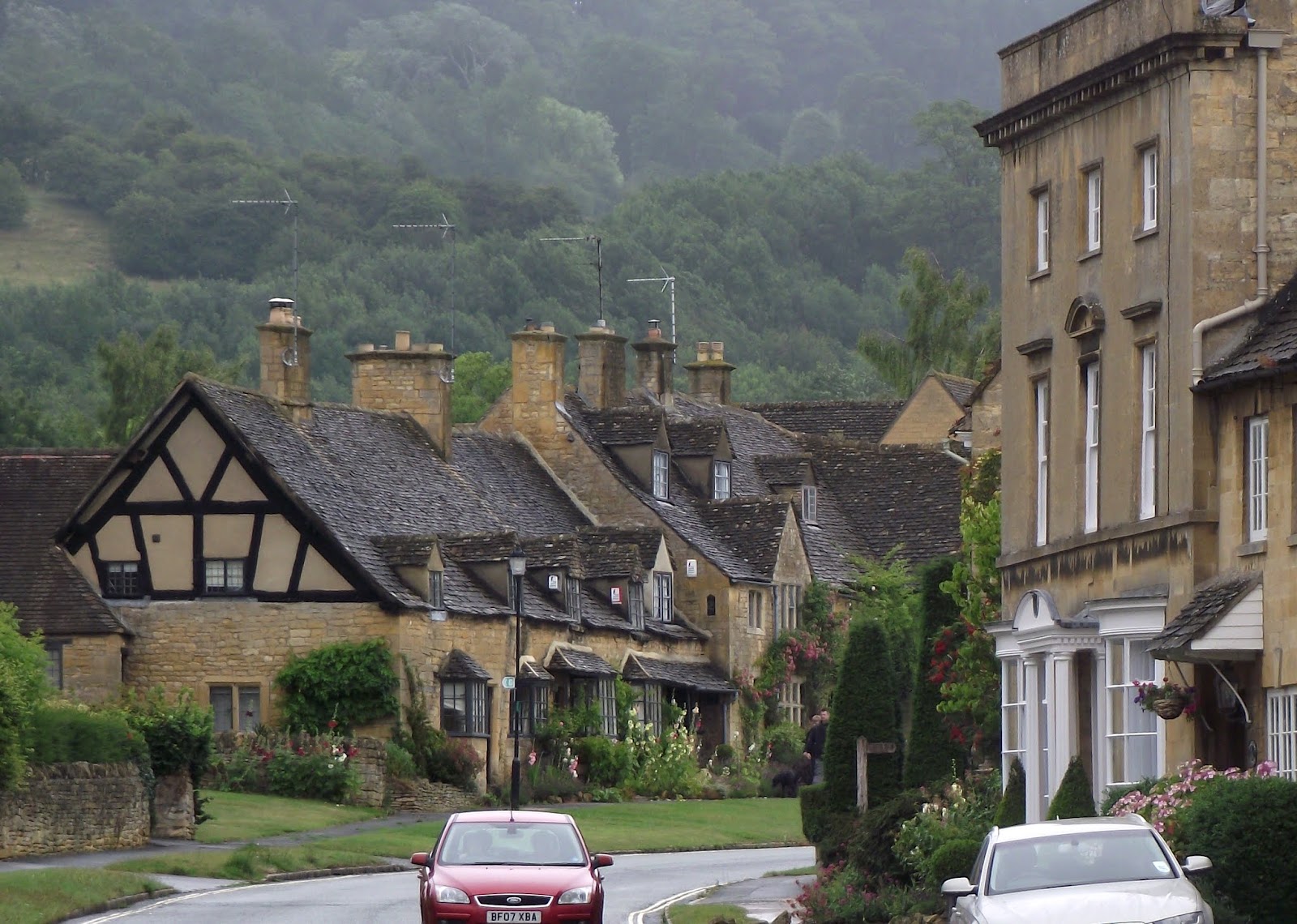
We're making a little walk-around in Broadway.  It's raining off and on, but that's what you expect in Britain.  This beautiful lush landscape didn't just happen. It takes a lot of consistent moisture to produce that beauty.  Broadway is considered one of the prettiest towns in England and, personally, I'd be happy to move in.


Day by day, I'm becoming more convinced that anytime you give an Englishman (or woman) a spit of land, they will landscape it to within an inch of its life.  We found examples everywhere.


And about that English reputation for dour faces?  Despite the Queen, I think they have wonderful senses of humor.  In her defense, I need to remember she has lots of important business to take care of.


We're moving on now to Stow-on-the-Wold, where we'll have time to explore the city center and find a bit of lunch.  We've opted for the White Hart, and are not disappointed.  I'm looking primarily for a roaring fireplace, but despite this Arizona girl's chilblains, the English are acting as if today, a little damp perhaps, is balmy overall.  It is July, after all, even at this latitude.


I'm opting for Baked Billy's egg, chorizo and etc.  Bruce was ready for hot, rich, thick soup of any sort accompanied by that promised local bread.  He wished for plates of that local bread.  The atmosphere here was friendly (we ate in the bar area) comfortable and familial.  I would like to add warm, but it was not, as the door to the patio remained open the entire time we were here.  Brrr.

After lunch and a chance to wander in and out of a few shops, we've departed Stow and are driving to Chipping Campden through fields and forests and pocket-sized villages, and it is beautiful.


We stopped at this charming little cemetery as we neared Chipping Campden.  It's still wet and windy, but Peter has a treat in store.  In the first paragraph above, I mentioned "Ridge and Furrow." This was the common manner of plowing in the Middle Ages, and the examples we see today survive from that period.  Plowing was done with teams of oxen and Peter is eager to demonstrate how those dramatic (especially when you consider they're hundreds of years old) ridge and furrows we see from the highways were actually formed.  We have assignments: Some of us are oxen, some are the ancient plow.  I'm an oxen, as is Bruce, although we're on different teams.  We proceeded to plow an abbreviated furrow and, as Peter directs our turn, we can visualize the ridge that we are creating for posterity. Centuries ago, the difference between the depth of the furrow and the height of the ridge could be as much as six feet.  I understand if you're scratching your head and thinking "Do I care about this?"  But, despite the weather, it was fun, and a great example of Peter's contagious enthusiasm for all things British. I couldn't leave it out.


I wonder if the British are much more likely to keep their cities and villages tidy and law-abiding simply because they word their requests so nicely.


These arched rafters make the Chipping Campden Market quintessential.  This open market near the center of the village was built in 1627, and has held up quite well.  Despite the rain, a merchant with beautiful sheepskins and furs has set up business.  His wares were so soft and rich, that if my suitcase had not been packed to the point of bursting, I would have been tempted.  Instead, I was simply complimentary.

It's late afternoon, and we've returned to Mickelton with plenty of time for a little snooze or, perhaps, a cup of tea and a really good book.  Dinner won't be served for a couple of hours yet and the Three Ways House Hotel has a lovely lounge designed for just this sort of quiet moment. Day Seven has been a great success.

10.04.2015

STONHENGE & BATH

As we walk down the steps of our London hotel for the last time (we're leaving this morning), our skies are a beautiful blue full of puffy, bright white clouds.  We feel a bit of breeze, but it's only enough to keep those little puff balls in motion.  We're right on time (7:00 a.m.) which, in some circles, is an ungodly hour, but we're packing in a lot today and can't miss our slot at Stonehenge. We're learning that tour groups in summertime England are held to a high standard of promptness.  

I was fortunate enough to have visited Stonehenge about 35 or so years ago, and was mightily impressed.  I can't wait to see it again.  The drive, like almost any drive in England, is lovely.  I'm always a bit starved for green and lush and trees and streams...and this is the perfect place for it.  I've found I can't read in the coach for fear of missing something outside.


Actually, it's just as I'd left it.  Oh, sure, there are some changes.  You're not going to wander through those massive bluestones anymore, or even get very close.  You will walk on a hard-surfaced (sometimes) path that circles the henge.  But dreams and wonder are still allowed, along with speculation and mystery. Stonehenge was probably constructed about 3000 to 2000 BCE...give or take.  Archeologists (of which Kevin, our guide, is one) continue to find postholes scattered throughout the area, but no clear answers as to why.  And, face it, we all want to know why.  Burial grounds, we understand, but what else?

The story I heard all those years ago regarding how the stones got here has also changed.  Whereas, we used to think they were brought by humans from many miles away, today you will be told they might have been carried here by the Irish Sea Glacier.  I love the way the English pronounce it as glass-ier.  No matter what the final answer, it's mind-boggling.

I did remember correctly that the henge is aligned with the sunrise of the summer solstice and the sunset of the winter solstice, but that still doesn't answer our "why" question.  Legends abound and many have spent entire careers studying the site.  I've decided to relax and enjoy the experience.

Stonehenge has up-scaled itself over the past few decades.  A Visitors Center has been built--the women's bathroom is very large, clean and well-stocked.  The adjoining cafĂ© and gift shop are also new and fresh, although  on this particular morning, the gift shop was wall to wall visitors.  Despite crawling through hordes of people from all parts of the world, I could tell that the merchandise was excellent and it receives one of my Five Star Gift Shop Awards.

I'm afraid I've sounded a bit negative about the crowds we've encountered during our first days here, and I'm sorry for that.  We visited during the prime season for tourists and we knew that when we booked.  Actually, Rick Steves writes that he prefers crowds when he travels, because they add such life to the surroundings.  And that is true.  It's fun to hear the different languages spoken and note that kids of all nationalities would much rather be left alone with their phones than forced to view yet another boring historical site.


Just outside the Visitors Center, Stonehenge has constructed a number of small huts that might represent housing for those who built this site over the years.  You can stop here and explore both before or after you visit the henge itself.  This is another wonderful place to let imagination run wild.


Visiting Bath  on the heels of Stonehenge was a remarkable juxtaposition for me.  The two are about 30 miles apart, so the trip is short in distance, much longer in centuries.  The Romans appeared in Britain early in the Common Era, and the famed baths were built not long after.  Of course, we're here to visit the baths and museum, but we're also soaking up the social life of the 18th and 19th centuries.  Anytime I'm walking on cobblestones that Jane Austen frequented, I'm a happy girl.


The museum here is excellent and one could spend hours..In fact, we did, and thus missed the walk to the Royal Crescent.  We caught up a little later when the coach left to meet the walkers, and we got our obligatory  photos.  Roman life is absolutely fascinating for me.  They were so civilized, although (if Rome and I Claudius were any indication) the homicide rate might have been slightly higher than ours today, but they designed comfort into much of their daily life and thoroughly enjoyed it.  Good for them
.


As near as I can remember, the bathing pool still looks very much like it did on my first visit.  The water continues to pour out of the ground amid clouds of steam.  The pool is quite warm and full of minerals or whatever, so bathing here is forbidden.  Close by, however, is a posh Spa Bath if you feel the need and have the cash.

I'm still a sucker for casement windows complete with flowerboxes, and they are plentiful in Bath.  Bath is bright and beautiful and history goes back forever.  3.8 million day-trippers arrive here each year, and I would come back for a longer stay.  Our Kevin leads a Road Scholar program that stays in Bath for a number of days.  That strikes me as being ideal.

I nearly missed telling you that this building is home to Sally Lunn's Buns, and considering the line every time we passed by, Sally Lunn's Buns are very popular.  The restaurant is open all day, reservations might be smart, and buns are sweet or savoury.  There is a certain protocol to eating a Sally Lunn Bun, but they seem willing to overlook the occasional lapse.